THE CANARY OF THE MOZAMBIQUE
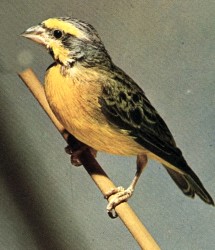
The Serinus kind is divided in approximately 40 species (and devout of 80 subspecies) devout famous di.le which the S. canarius (Canary) that it has truly conquered the world, becoming, after the dog, lanimale from company devout raised sulla earth. Today many other birds are following the fates of the Canary changing in the shape and in the color for being devout gradevoli allocchio human but nobody of these it belongs to the Serinus kind. Draft, in fact, of Diamonds Mandarin, Diamonds of Gould, Psittacidi, Verdoni, Lucherini, Ciuffolotti, Cardinalini of the Venezuela, Cardellini, Organetti and others. Not even the Verzellino (Serinus serinus) from many thought the Canary dEuropa, successful to hold head to conspecifico , in fact, still today questindigeno of difficult breeding and the little obtained, spontaneous mutations of color or traslate, (the Verzellino generates, coupled to the fertile Canary, prole hybrid) very rarely can be admired to the ornithological extensions. And in any case important to continue to try, the continuous steps ahead of the medicine veterinary, zootecnica dellalimentazione and of all the breeders, will carry us a day to exceed these difficolt. I want in order to describe unaltra to interesting species of the sort Serinus, in other words the Canary of the Mozambique (Serinus here mozambicus) that I have had occasion to raise and to reproduce some years orsono and that I potentially think a bird a lot adapted albreeders in cattivit.
Description
MALE: altogether along 11,5 cm approximately, it has yellow forehead sopracciglia and cheeks lemon, sides of the neck of green color clear olive, nape and back of the same color, streaked for of dark. Neck, mento and ventre yellow loaded lemon, remiganti and dark tawny helmsman. The picchiettati flanks are of yellow a little cargo and than green gray. Legs, dark spout and black nails tawny, eyes.YOUNG PEOPLE: they have a color much similar one to that one of the female, anchessi possess the collarino of dark pens on the chest, but remarkablly devout confused. After the first dumb possible one to distinguish easy the males from the females being observed the chest and listening to the song (the male of the Mozambique a great singer but nozzle often along I do not hiss).
DISTRIBUTION, HABITAT And FEEDING IN NATURE
The C. of the Mozambique alive still nellAfrica north orients them obviously, southern and in Mozambique. It attends open zones or with low vegetation and visit often fields subjects cultivate to you muovendosi in 50-80 flocks. Nutre of seeds of the graminacee wild that it has been cultivated, especially mile and panic. During the complete reproduction the diet with small bugs, larve and acarus.
SUGGESTED BREEDINGS by MENANDPETS.COM
No breeding to signal
if you want to know like signaling yours,
contacts: marketing@inseparabile.it
REPRODUCTION
In nature the riproduttivo period goes from September to January. The male corteggia the female with its song and once formed the brace he begins the construction of the nest that prepared on high not devout bushes of 5 meters. The nest of small dimensions with inner diameter of approximately 5 cm and one profondit of 3 cm. After to have placed three or four eggs the female them broods for 13 days and the male in this rather active phase, often nourishing the female. Like gi said, after 13 days dallinizio of it broods eggs schiudono and the chicks are feed to you in the first 5-6 days from the female, with larve dinsetti procurate from the male, which, after the 6 day contributes in direct way allalimentazione of the prole. To blind person 20 days from schiusa the small abandon the nest, remaining for with to the parents until the weaning, after that generally are drive away to you from the male.
we thank sig.ra Anna Rina for the
realization of this card