NAPOLITAN MASTIFF (Mastino Napoletano)
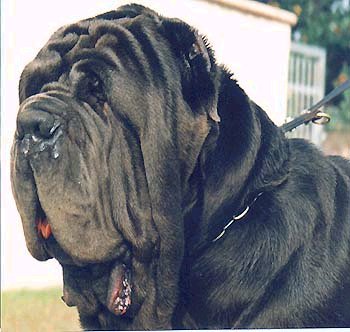
in
the photo: Dracula "of the gheno" Defined the same essence of the
race (Piero Scanziani).
FCI-Standard N° 197 / 10. 09. 1992 / GB
TRANSLATION : Mrs. Peggy Davis.
ORIGIN : Italy.
DATE OF PUBLICATION OF THE ORIGINAL VALID STANDARD : 27.11.1989.
UTILIZATION : Protection and guard dog.
CLASSIFICATION F.C.I. : Group 2 Pinscher and Schnauzer- Molossoid breeds and Cattle Dogs and other breeds.
Section 2.1 Molossoid breeds, Mastiff type.
Without working trial.
BRIEF HISTORICAL SUMMARY : The Neapolitan Mastiff is a descendant of the great Roman Mastiff described by Columelle in the first century A.D. in his book “de re rustica”. Widespread all over Europe by the Roman legions, with which he has fought, he is the ancestor of numerous mastiff breeds in the other European countries. Having survived as so many centuries in the countryside at the foot of the Mt.Vesuvius and in general in the region of Naples, he has been re-selected since 1947, thanks to the tenacity and devotion of a group of dog lovers.
SUGGESTED BREEDINGS by MENANDPETS.COM:
No breeding to signal
if you want to know like signaling yours,
contacts: marketing@inseparabile.it
GENERAL APPEARANCE : Large, heavy massive and bulky dog, whose length of body exceeds the height at the withers.
IMPORTANT PROPORTIONS : The length of the body is 10% more than the height at the withers. The ratio skull-muzzle is of 2 to 1.
BEHAVIOUR / TEMPERAMENT : Steady and loyal, not aggressive or biting without reason, guardian of the property and its inhabitants, always vigilant, intelligent, noble and majestic.
HEAD : Short and massive, with a skull wide at level of zygomatic arches; its length is about 3/10 of the height at the withers. Ample skin with wrinkles and folds of which the most typical and the best marked goes from the outer palpebral angle down to the lip angle. The upper longitudinal axes of the skull and the muzzle are parallel.
CRANIAL REGION : The skull is wide, flat, particularly between the ears, and, seen from the front, slightly convex in its fore part. The bizygomatic width is more than half the length of the head. The zygomatic arches are very prominent, but with flat muscles. The protuberances of the frontal bones are well developed; the frontal furrow is marked; the occipital crest is hardly visible.
Stop : Well defined.
FACIAL REGION :
Nose : Set in the prolongation of the muzzle, must not protrude beyond the outer vertical line of the lips; must be voluminous with large, well opened nostrils. Its colour is according to the colour of the coat : black for the black subjects, dark grey-brown in dogs of other colours, and chestnut for brown coats.
Muzzle : It is very wide and deep; its length corresponds to that of the fore-face and must be equal to the third of the length of the head. The lateral sides are parallel (between them), so that, seen from the front, the shape of the muzzle is practically square.
Lips : Fleshy, thick and full; upper lips, seen from the front, form an inverted “V” at their meeting point. The lower lateral profile of the muzzle is shaped by the upper lips; their lowest part is the corner of the lips, with visible mucous membranes, situated on the vertical from the external angle of the eye.
Jaws : Powerful with strong jaw bones and dental arches joining perfectly. Lower jaw must be well developed in its width.
Teeth : White, well developed, regularly aligned and complete in number. Scissor bite, i.e. upper incisors closely overlapping the lower ones in close contact, set straight to the jaw, or pincer bite, i.e. upper incisors meet edge to edge with the lower incisors.
Eyes : Set on an equal frontal level, well apart one from the other; rather round, slightly deep set. Compared with the coat colour, the colour of the iris is darker. The eye may nevertheless be lighter in coats of diluted shades.
Ears : Small in relation to the size of the dog, of triangular shape, set above the zygomatic arch, they are flat and close to the cheeks. When they are cropped, they have the form of an almost equilateral angle.
NECK :
Profile : The upper profile is slightly convex.
Length : Rather short, measures about 2,8/10 of the height of the withers.
Shape : Conical trunk shaped, well muscled. At mid-length the perimeter is equal to about 8/10 of the height of the withers.
Skin : Lower edge of the neck is well endowed with loose skin which forms a double dewlap well separated, but not exaggerated; starts at level of the lower jaw and does not go beyond middle of the neck.
BODY : The length of the body exceeds by 10% the height at the withers.
Top line : Top line of the back is straight; withers are wide, long and not very prominent.
Back : Broad and of a length about 1/3 of the height at the withers. The lumbar region must be harmoniously united with the back and muscles and well developed in width. The ribcage ample, with long and well sprung ribs. The circumference of the thorax is about ¼ more than the height at the withers.
Rump : Wide, strong and well muscled. Its obliqueness compared with the measured horizontal on that of the hip bone (coxal) is about 30°. Its length is equal to 3/10 of the height at the withers. The hip bones are prominent to the extent of reaching the top lumbar line.
Chest : Broad and wide with well developed chest muscles. Its width is in direct relation with that of the ribcage and reaches the 40-45% of the height at the withers. The tip of the sternum is situated at the level of the scapular-humeral joint.
TAIL : Broad, and thick at its root; strong, tapering slightly towards the tip. In length it reaches the articulation of the hock, but usually is docked at about 2/3 of its length. At rest is carried hanging and curved in sabre fashion, in action lifted horizontally or slightly higher than the top line.
LIMBS
FOREQUARTERS : On the whole, the forequarters, from the ground to the point of the elbow, seen in profile and from the front, are vertical with a strong bone structure in proportion with the size of the dog.
Shoulders : Their length measures about 3/10 of the height at the withers with an obliqueness of 50°-60° on the horizontal. The muscles are well developed, long and well defined. The angle of the scapulo-humeral articulation is of 105°-115°.
Arm : Measures about 30% of the height at the withers. Its obliqueness is of 55°-60° furnished with significant musculature.
Elbows : Covered with abundant loose skin, they are not too close to the body.
Forearm : Its length is almost the same as that of the arm. Placed in perfect vertical position, of a strong bone structure, with lean and well developed muscles.
Pastern joint : Broad, lean and without nodosity, continues the vertical line of the forearm.
Pastern : Flat, continues the vertical line of the forearm. Its inclination on the horizontal towards the front is about 70° to 75°. Its length is equal to about 1/6 of the length of the limb from the ground up to the elbow.
Forefeet : Of round shape, large, toes well arched and well-knit. The pads are lean, hard and well pigmented. The nails are strong, curved and of a dark colour.
HINDQUARTERS : On the whole they must be powerful and sturdy, in proportion with the size of the dog and capable of the required propulsion in movement.
Upper thigh : In length measuring 1/3 of the height at the withers and its obliqueness on the horizontal is about 60°. It is broad with thick, prominent but clearly distinct muscles. The thigh bone and the tip bone (femur and coxal) form an angle of 90°.
Stifle : The femoral-tibial (hip bone-shin bone) angle is about 110°-115°.
Lower thigh : Length slightly inferior to that of the thigh and of an obliqueness of 50°-55°, with strong bone structure and well visible musculature.
Hock joint : Very long in relation to the length of the leg, its length is about 2,5/10 of the height at the withers. The tibial-tarsal articulation forms an angle of 140°-145°;
Hock : Strong and lean, its shape almost cylindrical, perfectly straight and parallel, its length is about ¼ of the height at the withers; eventual dewclaws should be removed.
Hindfeet : Smaller than the forefeet, round with well-knit toes. Pads dry, hard and pigmented. Nails strong, curved and of dark colour.
GAIT / MOVEMENT : This constitutes a typical characteristic of the breed. At the walk, the gait of feline type of lion steps, is slow and resembles that of a bear. The trot is distinguished by a strong thrust of the hindquarters and a good extension of the forequarters. The dog rarely gallops; usual gaits : walk and trot. Pacing is tolerated.
SKIN : Thick, abundant and loose all over the body, particularly on the head where it forms numerous folds and wrinkles, and at the lower part of the neck where it forms a double dewlap.
COAT
HAIR : Short, rough and hard, dense, of the same length all over, uniformly smooth, fine and measures 1,5 cm maximum. Must not show any trace of fringing.
COLOUR : Preferred colours are : grey, leaden grey and black, but also brown, fawn and deep fawn (red deer), with, sometimes, little white patches on the chest and on the tip of the toes. All these coats may be brindled; hazel, dove-grey and Isabella shades are tolerated.
SIZE AND WEIGHT :
Height at withers : Males : 65-75 cm.
Females : 60-68 cm.
Weight : Males : 60 - 70 kg.
Females : 50 - 60 kg.
FAULTS : Any departure from the foregoing points should be considered a fault and the seriousness with which the fault should be regarded should be in exact proportion to its degree.
SERIOUS FAULTS :
- Pronounced undershot mouth.
- Gay tail (trumpet tail).
- Sizes bigger or smaller than the limits allowed.
ELIMINATING FAULTS :
- Overshot mouth.
- Accentuated convergence or divergence of the facial-cranial axes.
- Topline of muzzle concave or convex or very aquiline (Roman nose).
- Total depigmentation of nose.
- Wall eye; total depigmentation of both rims of eyelids; cross eyed.
- Absence of wrinkles, folds and dewlap.
- Absence of tail whether congenital or artificial.
- Extensive white patches; white markings on the head.
N.B. : Male animals should have two apparently normal testicles fully descended into the scrotum.
Automatic translate from inseparabile.com
Nazionalit Italy.
Origin
All Mastiff the
Europeans come down dall.antico Mastiff of Tibet, devout the ancient
exponent of the canine species. Probably the first Mastiff ones
asiati have been capacities dall.India in Greece from Alexander
Magno, approximately in the 300 aC. The Greeks introduced them the
Roman, than if entusiasmarono some and used them in the combats from
circus. The mastiff word drift from the Latin massivus, that it means
massive.
The Mastiff Neapolitan however
the directed dell.antico descendant roman Molosso. While the race
went extinguishing itself in all Europe, in Campania l.breeders
it continued in spite of the insidie of the time and the wars. Pu
therefore to assert that the Mastiff Neapolitan alive in Campania
from at least two thousand years, even if its first official
apparition of 1946 and its standard of 1949.
Description
Height for the
males: 65-75 cm; for the females:
Character
In spite of the
burbera and even feracious appearance, also the Mastiff Neapolitan a
pacific dog, balanced, sweet and affectionate with the master and
the friends of house. And an animal much brave one, that it knows to
resist with fierezza to the physical pain.
Use
In the course of the
history the Neapolitan Molosso be dog from war, combatant from
circus, collaborator of the gangsterism and ausiliario.della police,
dog from towing, company, personal defense. Today, if trained, pu to
become an excellent guardiano of the house and defender of the
person.
Feeding
The Neapolitan
Molosso to have above all nourished with meat (700 grams to the day)
and laughed, or bread. It does not go swollen with zuppe and
verdure. perch it would become flabby and lose in vivacit.
Notes And a dog that needs much physical exercise, perci adapted to living in a house with garden, or apartment, in case a person of good muscles can carry it two times to the day to complete one long walk.
|
Official standard ENCI Short historical signals:It comes down from large molosso the roman one, described from Columella (the sec.) in Peasant De KING, diffused in all Europe from the Legions of Rome, to the flank di.le which have fought, contributing in the formation of many breeds of mastiff in the other European countries. Conserved, along many centuries in the vesuviana campaign and the Neapolitan region, kind, state riselezionato after 1947.
|